
The growth of the AI voice generator market reflects a broader shift toward automated content production across video, audio, and interactive media. Tools in this category are increasingly used to replace traditional recording workflows, especially in fast-paced digital environments where speed and scalability matter more than studio setups.
This article examines five widely used platforms, focusing on how each AI voice generator is positioned, what users typically rely on them for, and how they compare in practical production contexts.
1. Pollo AI Voice Generator
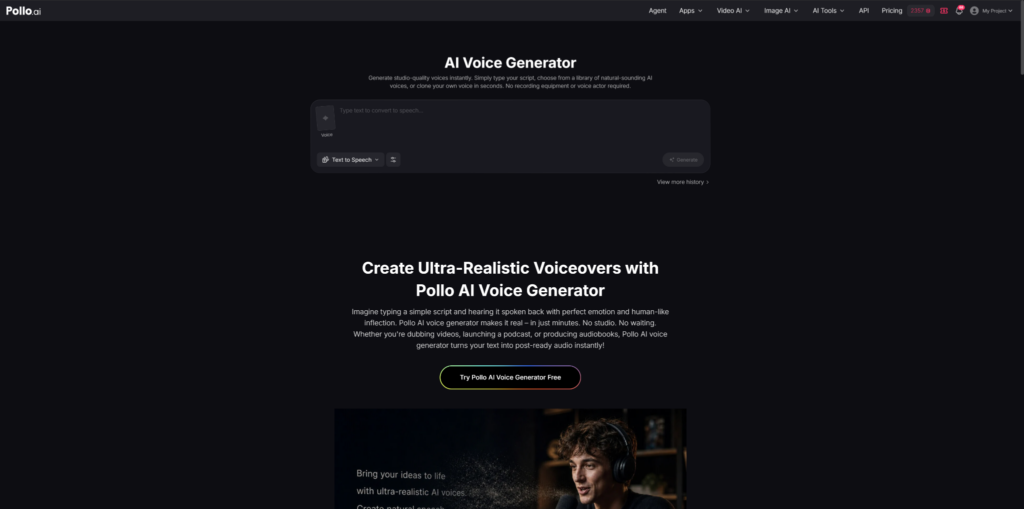
Pollo AI Voice Generator is presented as a multi-functional AI voice generator designed to convert written scripts into studio-quality speech without requiring recording equipment or professional voice actors. It positions itself as a practical solution for creators who need fast voice production for video, podcast, advertising, or educational content. The system allows users to either generate speech from text or clone a voice, offering flexibility for different production needs.
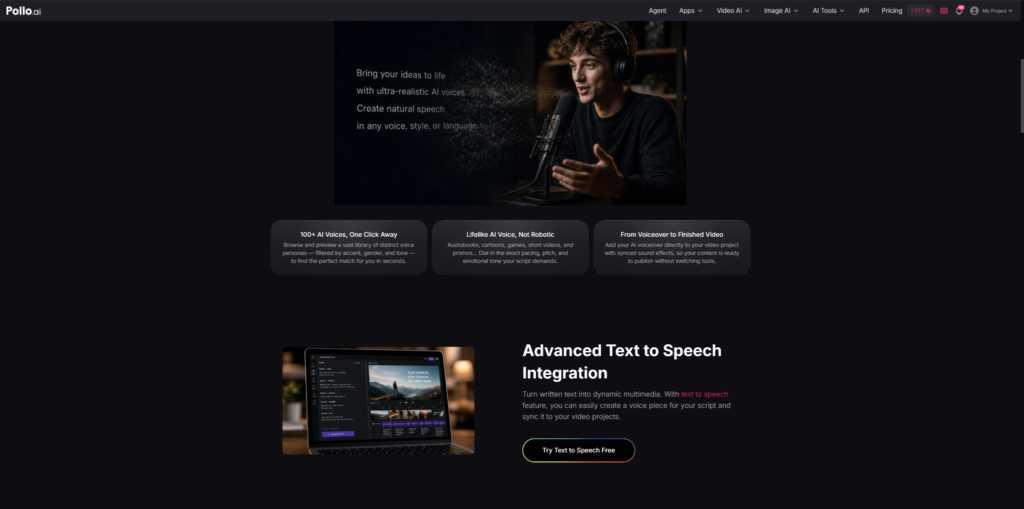
The platform typically includes a library of 100+ AI voices, categorized by tone, accent, and style, which helps users quickly match voices to specific content types. It also supports text-to-speech workflows with adjustable pacing, pitch, and emotional tone. In addition, Pollo AI integrates voice output into broader content workflows, enabling direct syncing with video projects so that users do not need separate editing tools for audio alignment.
Why Users Choose Pollo AI Voice Generator
Pollo AI Voice Generator is often selected for its speed and consolidation of multiple production steps into a single interface. Based on typical user feedback patterns across AI content tools, creators tend to value its ability to generate natural-sounding narration quickly without needing post-production editing software. This makes it particularly relevant for short-form video creators and marketing teams working under tight deadlines, especially in commercial workflows where an AI UGC video ads generator is used to rapidly produce social media advertising content. In these scenarios, Pollo AI Voice Generator can be combined with an AI UGC video ads generator to create seamless, high-quality commercial advertisements with synchronized voiceovers and visuals, reducing the need for separate production tools.
Another commonly cited advantage is its “all-in-one” workflow approach, where voice generation can be directly linked with video production. Users working on YouTube content, TikTok ads, or e-learning materials often prefer this setup because it reduces tool-switching and editing complexity. In particular, marketing teams leveraging an AI UGC video ads generator find it useful to integrate Pollo AI Voice Generator for generating consistent brand narration across multiple ad variations. However, some users note that while it performs well for general narration and marketing content, highly specialized voice acting tasks may still require more advanced studio-grade tools.
2. OpenAI Voice (GPT Voice)
OpenAI Voice, often associated with GPT-based systems, functions as a conversational AI voice generator designed to support real-time spoken interaction rather than purely scripted narration. It is built around language models that generate speech dynamically based on context, allowing users to interact with AI systems in a more natural conversational format. This positions it more as a voice interface technology than a traditional voiceover tool.
The system typically emphasizes contextual awareness, meaning that it can adjust tone, pacing, and phrasing depending on user input. Instead of relying on pre-recorded voice templates, it generates speech on demand, which makes it suitable for interactive environments such as AI assistants, customer support automation, and educational dialogue systems. Its strength lies in responsiveness rather than studio-style audio production.
Why Users Choose OpenAI Voice
Users often adopt OpenAI Voice for applications where interaction quality matters more than voice customization depth. In practical usage scenarios reported across AI assistant deployments, it is valued for its ability to maintain coherent, real-time conversations with natural-sounding speech output. This makes it particularly useful in customer service bots and accessibility tools.
Another reason for adoption is its strong integration with conversational AI ecosystems. Developers tend to use it when building voice-enabled applications that require seamless dialogue flow. However, users generally observe that it is less focused on voice cloning or creative narration compared to dedicated voice generation platforms, making it better suited for functional communication rather than media production.
3. ElevenLabs AI Voice Generator
ElevenLabs is widely recognized as a high-fidelity AI voice generator specializing in realistic speech synthesis and expressive voice modeling. It is designed for users who require human-like narration quality, including audiobook producers, video creators, and localization teams. The platform supports voice cloning and fine-tuned emotional control, allowing users to generate highly detailed voice outputs.
The system is built on advanced deep learning models that focus on natural prosody, intonation, and emotional variation. It offers multilingual support and is frequently used for long-form audio content such as audiobooks, podcasts, and cinematic narration. Its primary value lies in producing voices that closely resemble real human speech patterns.
Why Users Choose ElevenLabs AI Voice Generator
Based on common usage patterns in creative industries, ElevenLabs is often selected for projects requiring high emotional realism. Users in audiobook production and gaming voice design tend to favor it because it produces expressive narration that reduces the need for manual voice acting. Its voice cloning feature is also frequently highlighted as a key advantage.
At the same time, some users note that achieving optimal results may require more careful input tuning compared to simpler tools. However, its output quality is often considered worth the additional effort, especially in professional storytelling environments where voice authenticity is critical.
4. LOVO AI (Genny) AI Voice Generator
LOVO AI (Genny) operates as a content-focused AI voice generator integrated into a broader multimedia creation platform. It is designed for marketers, educators, and business users who need both voice generation and video narration capabilities. The system provides a large voice library and supports multiple languages, making it suitable for global content distribution.
The platform enables users to convert scripts into voiceovers and directly integrate them into video projects. It includes editing controls for adjusting pacing, pronunciation, and tone, which helps align voice output with different content formats such as advertisements, training materials, and explainer videos.
Why Users Choose LOVO AI (Genny) AI Voice Generator
From a usage perspective, LOVO AI is often chosen for its balance between usability and structured workflow integration. Users in marketing and corporate training environments commonly prefer it because it simplifies the process of turning scripts into publishable media assets. Its combined voice-and-video workflow reduces production time.
Some users note that while its voices are generally consistent and clear, they may not always match the emotional depth of more specialized audio tools. However, its practical advantage lies in workflow efficiency, especially for teams producing high volumes of structured content.
5. Kits AI Voice Generator
Kits AI is a creative-focused AI voice generator primarily used for voice conversion and music-related applications. Unlike traditional narration tools, it is designed for audio manipulation, including singing voice transformation and vocal style experimentation. This positions it strongly within the music production and sound design community.
The platform allows users to apply AI voice models to existing audio or generate synthetic vocal outputs. It supports voice cloning and is often used for remixing, vocal layering, and experimental audio workflows. Its feature set is oriented toward creative sound production rather than commercial narration.
Why Users Choose Kits AI Voice Generator
Users in music production environments often adopt Kits AI because of its flexibility in transforming vocal characteristics. Based on common practitioner discussions, it is valued for enabling experimentation with different vocal styles without requiring multiple singers or recording sessions. This is particularly useful in independent music production.
However, users also note that it is less suitable for standard business narration or educational content. Its strengths are concentrated in creative audio manipulation, making it a niche but powerful tool for producers working with AI-assisted music workflows.
Final Thoughts
The AI voice generator landscape in 2026 reflects clear specialization across different user needs. Pollo AI and LOVO AI focus on integrated content workflows, ElevenLabs emphasizes high-quality expressive narration, OpenAI Voice supports real-time conversational systems, and Kits AI targets music and audio experimentation.
Overall, selection depends on whether users prioritize speed, realism, interactivity, or creative control. As AI voice generation continues to evolve, these tools are increasingly becoming core infrastructure in digital content production rather than optional utilities.