
The advancement of AI Video technologies has given creators the potential to create content faster than ever before and with revolutionary creative possibilities.
This guide breaks down these technologies.
AI Video Prompting Guide
The AI Video Prompting Guide serves as the foundation for transforming ideas into polished videos.
It emphasizes structured prompting: define the core subject first, then layer in descriptors for style, motion, camera work, and atmosphere.
For example, avoid the generic “city scene” and instead write “bustling nighttime metropolis with neon lights flickering, slow drone pan from street level to skyline, rain-slicked pavement reflecting headlights”.
To better convey intentions without repeated effort by the AI, use active verbs such as “characters stride purposefully”.
Use technical specifications: “4K resolution, 24fps, shallow depth of field”.
Experiment with negative prompts: “no blurriness, avoid unnatural lighting” to exclude unwanted results.
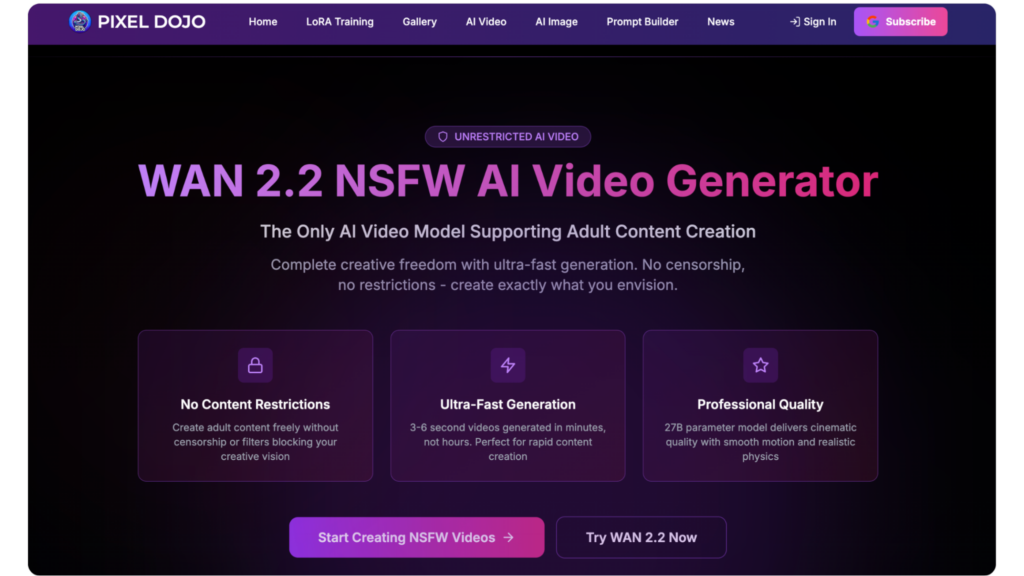
Examples of such tools exist, such as Pixel Dojo, which embeds the principles in its development.
Building Scenes Layer by Layer
Complex videos can be built up using multiple layers, e.g. a static background like a calm forest or a futuristic laboratory, which is then overlaid with animated characters or floating particles.
This allows for simple editing of elements without requiring the entire scene to be regenerated.
For effects like shadows cast across surfaces, a transparency mask can be combined with prompts such as “gentle dissolve revealing hidden layers” or “explosive shatter effect transitioning to new vista”.
After you’ve practised the above layers, go for 3 to 5 key elements with subtle movements like a tree swaying or water rippling to create an organic feel.
This can be done with clips that are a few seconds long, in one shot, or over multiple shots or a longer piece.
Enhancing Audio and Voice Integration
For audio, synthetic speech can be used to fit user-controlled specifications (e.g. “confident baritone with rising inflection on key points”) and sync to the model’s mouth position.
Such a model can also have various audio layers, such as e.g. footsteps echoing in a hall or the crackling of a cabin fire.
The timing of the music and audio effects to visual cues (e.g. dramatic pauses before revealing the big bad) adds to the experience without taking up too much room in dialogue.
The ambiance is created by “ethereal synth swells building to orchestral crescendo”.
The levels are balanced so even simple generations create professional, industry-quality productions.
Stylizing for Unique Visual Identity
Style transfers can illustrate a character’s personality (such as “oil painting textures over hyper-realistic figures” or “retro pixel art with smooth gradients”).
The art movement or hybrids can craft a distinct look for the content (e.g. “noir shadows and high-contrast monochrome akin to classic detective stories”; “steampunk machinery in a lush jungle”).
The style of each video adapts to the platform (vertical format for mobile feeds and square format for social previews) while animated transitions between styles (such as sketchy line art and illustrated color) and production stylizations are instantly recognizable to the brand.
Streamlining Editing and Post-Production
AI can edit these quickly with appropriate prompts.
Prompt automatic cuts that can be expressed with visuals and sound: “montage of quick zooms synced to rhythmic music, crossfades every two seconds”.
Text can be animated: “serif letters typing out sequentially, glowing on emphasis”.
This avoids overwhelming the audience.
‘Color grading’, such as “warm golden hour tones with desaturated backgrounds”, gives visual coherence, and ‘speed ramping’ like “slow-motion impact followed by accelerated chase”, a cinematic feel.
Shakiness is reduced, and details are sharpened.
This operation would have taken hours, but is now achieved in minutes.
Achieving Hyper-Realism and Fluid Motion
For realistic prompts, refer to physics, e.g., “the cloth billows naturally in crosswind, the hair moves with realistic volume.”
For interactions, include details, e.g., “the coffee steam rises curling around the rotating mug.” For multi-shot images, keep lighting and proportions consistent.
Micro details such as particles of dust in the air, muscle twitches, or small folds in clothing, and environmental details such as mist over hills or waves breaking with foam, as well as the action paths of the fluid motions, such as “orbiting camera circling a levitating orb”, are very flexible, as in high-end CGI.
Scaling Production for High Volume
Batch prompting eases rapid content generation.
Prompt with “same scene in dawn, dusk, and stormy variants.”
Or for A/B test thumbnails, use different poses and compositions.
Libraries such as “epic landscape pack” or “corporate explainer set” allow for rapid reuse.
Once adapted, 15-second hooks can be used for shorts, two-minute embeds, and stills of screengrabs can be pulled from the video and used as a graphic piece.
This makes it easy to build daily content calendars without sacrificing quality.
Iterating with Feedback and Analysis
Test your opening with criteria like: does it hook the audience?
Does it flow?
Does it pack an emotional punch?
A command like “boost vibrancy by 20%, smooth jerky pans” is clearer than an implicit one.
Keeping a journal (log of high-engagement scenes e.g. “urban chase: tumultuous wind, handheld shake”), being aware of where viewers lose interest, and seeing anonymized clips in the community accelerates the field’s improvement.
Optimizing for Engagement and Reach
Explosive opening hooks, visually evocative questions, and the story arcs of setup, conflict, and resolution hold audience attention.
Calls to action often naturally occur, such as pulsing animated icons.
Platforms tailor for performance: trending audio for verticals, low-context captions for horizontals, and the viral structure of memes: relatable characters, surprises.
Monitor metrics such as completion rates and emotional highs and lows to adapt.
Future-Proofing Your AI Video Skills
Tools regularly receive new prompts (lighting models, physics engines, etc.).
Hybrid workflows, where rough AI drafts are polished by human artists, yield the best images. Ethics and diverse representations are also part of this.
Iterating on all those aspects, from the mood settings of imagery or branching narrative structure, will allow the creator to be at the cutting edge of visual storytelling in the game.
