

You have an idea. Maybe it keeps you up at night. But ideas are cheap. Execution is expensive, and building the wrong thing is catastrophic. Product discovery is how you de-risk that leap before writing a single line of code. It’s the phase where you test assumptions, talk to actual users, and figure out if your solution solves a real problem. Different firms approach this differently.
Some are killers at startup validation, moving fast and dirty to test product-market fit. Others specialize in enterprise product strategy, dealing with complex stakeholder maps and technical constraints. We think both have their place. This list reflects that range.
Avenga
You call Avenga when you need structure. When the idea is there but the path forward is foggy, they provide a framework. They fit best for companies, often mid-market or enterprise, that need a disciplined discovery phase before scaling a digital service or launching a new platform.
You’re probably past the napkin-sketch stage if you are considering Avenga Product Discovery Services & Consulting. You have some resources and domain knowledge, but you need validation from a team that can also build what they discover. They tend to focus on discovery that feeds directly into delivery. No handoff friction.
Best Fit Scenarios
Their engagements assume you’re serious. Maybe you’re a scale-up with funding, or an enterprise launching a new vertical. The goal isn’t just to validate; it’s to create a blueprint that a development team can execute against immediately. They bridge the gap between strategy and code.
A practical Avenga engagement usually starts with a business problem and ends with a buildable plan. The discovery phase is treated as the foundation for the product, not a separate research exercise. Typical scenarios include:
- Validating product concepts before committing development budget;
- Defining MVP scope and feature roadmap with clear priorities;
- Conducting technical discovery to assess platform constraints;
- Aligning stakeholder expectations around product vision and timeline.
The output is a plan you can actually hand to engineers. No ambiguity.
Uptech
Uptech lives in the startup world. They work with founders who have an idea and maybe some seed funding, but need a partner to help validate and build the first version. Their process is lean and fast. They push for user interviews early, often before anything is designed. According to their data, talking to users before writing specs prevents the biggest mistakes. They’re a good fit if you’re pre-product-market fit and need to move quickly without wasting cash on features nobody asked for.
Discovery Strengths
Speed matters when the runway is short. Uptech seems to understand that. Their discovery phase is built to validate or invalidate hypotheses quickly, so you can pivot or proceed with confidence.
Startups don’t have time for months of analysis. They need answers. Uptech’s discovery is geared toward rapid validation. Key strengths include:
- User interview frameworks that surface real pain points;
- Rapid prototyping to test concepts before building;
- MVP scoping focused on the smallest testable version;
- Product-market fit assessment to guide go-to-market strategy.
It’s built for founders who need to move.
Netguru
Netguru is known for structured product workshops. They’ve done a lot of them, often with clients who have a business need but haven’t translated it into technical requirements. Their approach is heavily UX-driven. They map user journeys, build prototypes, and test assumptions about usability before development starts. It’s a good fit if you have a clear business problem but need help turning that into a product definition that designers and developers can actually use.
Discovery Capabilities
The workshop model works when you need to align a team quickly. Netguru brings stakeholders, designers, and developers into the same room (or virtual room) to hash out the product concept in a compressed timeframe.
Netguru’s discovery is built around collaborative workshops that produce concrete outputs. Their capabilities include:
- Design sprints to prototype and test product concepts rapidly;
- UX research and user journey mapping to identify friction points;
- Technical discovery to validate feasibility and estimate effort;
- Product strategy and roadmap definition for the build phase.
You walk out with a plan, not just notes.
OAK’S LAB
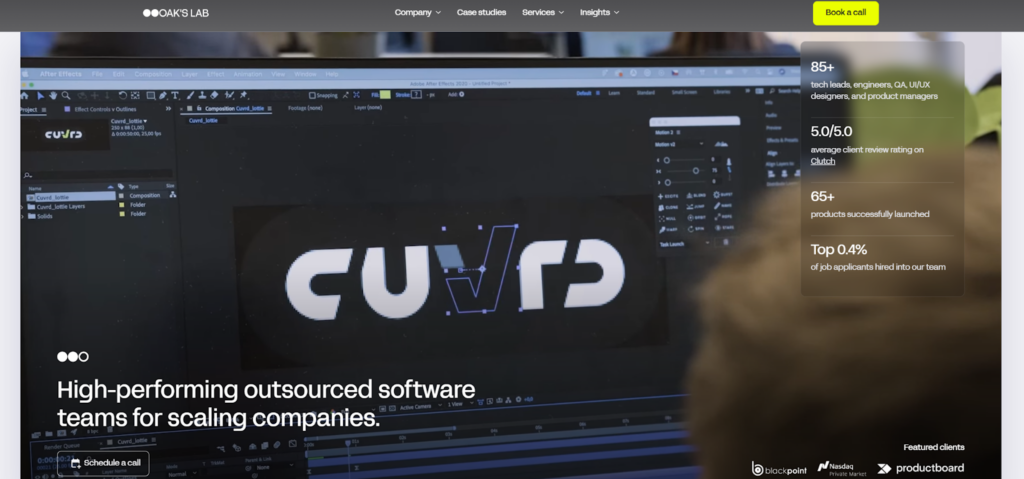
OAK’S LAB positions itself as a product studio for startups. They work with founders to shape ideas into investable products. Their focus is on business logic as much as user experience. They want to know: Does this make money? Does it solve a problem people will pay for? Their discovery phase tends to produce MVPs that are lean but functional, designed to reach the market quickly and start generating feedback and revenue.
Typical Discovery Deliverables
They’re pragmatic. The output of discovery should be something you can build from and show to investors. It’s about de-risking the business model, not just the user interface.
OAK’S LAB focuses on translating ideas into viable products. Their discovery phase produces tangible assets for founders. Typical deliverables include:
- Business model validation and revenue stream analysis;
- User flow mapping and wireframes for key product journeys;
- Technical specifications and architecture recommendations;
- MVP roadmap with phased feature releases and success metrics.
It’s designed to get you to launch with confidence.
S-PRO
S-PRO leans technical. They’re strong when the product idea involves complex systems, integrations, or data challenges. If your MVP requires talking to legacy enterprise software or handling sensitive data, you want technical discovery early. They assess the architecture, identify integration pain points, and plan the technical foundation before design even starts. It saves you from building a pretty front end on a foundation of sand.
Technical Discovery Focus
Some products fail not because the idea is wrong, but because the technical implementation is a nightmare. S-PRO focuses on preventing that. They dig into the system architecture, data models, and integration requirements before any code is written.
When the technical risk is high, discovery needs to address it head-on. S-PRO’s focus areas include:
- Technical feasibility studies for complex product requirements;
- System architecture design and technology stack selection;
- Integration planning with existing enterprise systems or APIs;
- Security and compliance assessments for regulated industries.
You get a technical foundation that won’t collapse under pressure.
How to Choose a Product Discovery Partner
Look at your stage. A pre-revenue startup needs speed and business model validation. A scale-up needs a process and scalability planning. An enterprise needs governance, an integration strategy, and stakeholder alignment. Pick the partner whose strengths match your critical path. Don’t hire a technical architect to validate your brand positioning. Don’t hire a UX studio to figure out your legacy system integration. Match the problem to the toolkit.
Key Selection Criteria
You’re hiring for a specific capability. We think you should evaluate based on what they’ve actually delivered for companies like yours. Look for signals, not slogans.
When evaluating partners, consider these practical criteria:
- Relevant experience with your business stage and industry;
- Clear methodology for user research and problem validation;
- Ability to translate discovery outputs into development-ready specs;
- Track record of products that successfully launched and grew.
The right fit saves you money and time. The wrong fit costs both.
Conclusion
Discovery is insurance. You spend a little time and money upfront to avoid wasting a lot later. It helps you understand users, test your assumptions, and define a product that has a real chance in the market. The five firms above offer different paths through that process. Pick the one that matches your risk profile and get started. Building the right product beats fixing the wrong one every time.