
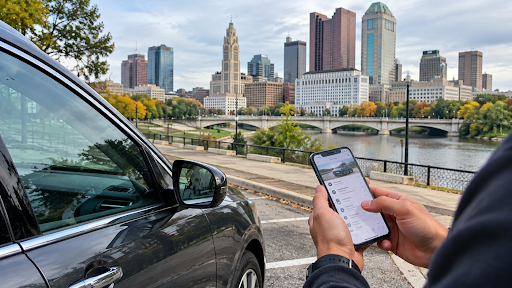
If you’ve renewed a policy in the last couple of years, you may have noticed the change. Your insurer’s app now asks permission to track how you drive, the ID card lives on your phone, and a claim starts with photos instead of a phone call. None of it is dramatic. Together, it changes how you buy, prove, price, and claim on car insurance in Ohio.
Some of this saves you money and some of it just moves the work onto you. Here’s what’s different, what Ohio still requires underneath the technology, and what to ask before you agree to anything.
Your phone is now your proof of insurance
Ohio has accepted electronic proof of insurance since March 2015, when the Ohio Department of Insurance approved smartphones and similar devices for showing coverage to police, courts, and the BMV. A clear photo of your insurance ID card counts, and so does your insurer’s app.
The legal minimum underneath hasn’t changed. Ohio requires 25/50/25 liability coverage, meaning $25,000 for one person’s injuries, $50,000 for all injuries in a crash, and $25,000 for property damage. Driving without proof of insurance or other financial responsibility is illegal in the state.
The part people forget is random verification. The Ohio BMV selects roughly 5,400 registered vehicles a week and asks the owners to show proof of coverage on a specific past date, according to reporting by the Akron Legal News. If you can’t show it, you can lose driving and registration privileges until you meet the Ohio BMV reinstatement requirements, which include proof of insurance and a fee. A phone screenshot works at a traffic stop. For a BMV letter, save the declarations page from each policy period, since it shows the exact dates you were covered.
Telematics: a discount in exchange for your driving data
Usage-based programs are the biggest shift. An app or plug-in device records how you drive, usually braking, speed, time of day, mileage, and sometimes phone use. The insurer scores it and adjusts your price. Ohio has a particular connection to this, since Progressive, based in Mayfield Village outside Cleveland, has run a telematics program called Snapshot for years.
Whether it pays depends on how you drive. A retiree who drives a few miles a week on surface streets in Dayton may do well. A commuter who brakes hard at the I-270 outerbelt merge, or someone who works late nights, may not.
Before you enroll, find out three things. Can the program raise your rate, or can it only lower it? How long does the monitoring last, and does it end after a trial period? Who can the insurer share the data with? Some programs give a small discount just for signing up and then adjust it at renewal, and others reprice you continuously. The answers vary by carrier, so read the terms and not the marketing.
Winter complicates this. Lake-effect snow in Cleveland and the snowbelt counties can force sudden stops that score badly, even when you drove carefully for the conditions.
Quotes in minutes, and why the price can change
Buying has gotten much faster. You enter a VIN and an address, the carrier’s system pulls your driving record and claims history in seconds, and a price appears on screen. For many drivers, the whole transaction takes ten minutes.
The speed has a catch. A fast quote relies on what the system finds about you, and the final price can move once it verifies details you didn’t mention. A ticket from two years ago, a second driver, or a different garaging address can all change the number.
When you compare auto insurance Ohio carriers sell, give every site the same VIN, address, drivers, mileage, limits, and deductibles, and note which discounts each quote already includes. Different inputs produce different prices that look like real differences between companies. Include a mix of national and regional carriers. GoAuto Insurance, a regional insurance company offering cheap car insurance, is one example, and Progressive and Grange, both with Ohio roots, are others.
If you’d rather talk to a person, an independent agent can pull several quotes at once, though you should ask which companies they work with.
Claims by photo
Many carriers now let you file a claim by uploading pictures of the damage and getting a repair estimate back quickly, sometimes the same day. It’s convenient after a fender-bender in a Kroger parking lot, and the speed is real.
The estimate is a starting number. Shops often find more damage once a bumper comes off, and that shows up as a supplement to the original estimate. If a photo estimate seems low, take the car to a shop you trust and ask them to send the insurer a written estimate. Photograph everything at the scene, including the other car’s plate, before you leave.
You’re also not obligated to use the insurer’s preferred shop. Ohio drivers can generally choose where the car gets repaired, but ask your carrier how its direct-repair program works before you decide, since some tie a guarantee to their network.
What to do at your next renewal
You don’t need to adopt every new feature. A short set of questions covers most of it:
- Does my current carrier offer a usage-based program, and can it raise my rate?
- Is my declarations page saved from every policy period?
- Are my limits still where I want them, or have I let them sit at the minimum?
- Would a photo-based claim process work for me, or do I want a shop to look at the car first?
- When I compare quotes elsewhere, am I using identical inputs on every site?
Pick the two that matter most to you and spend an evening on them. Technology is mostly a way to get to the same decisions faster, and the decisions are still yours.