
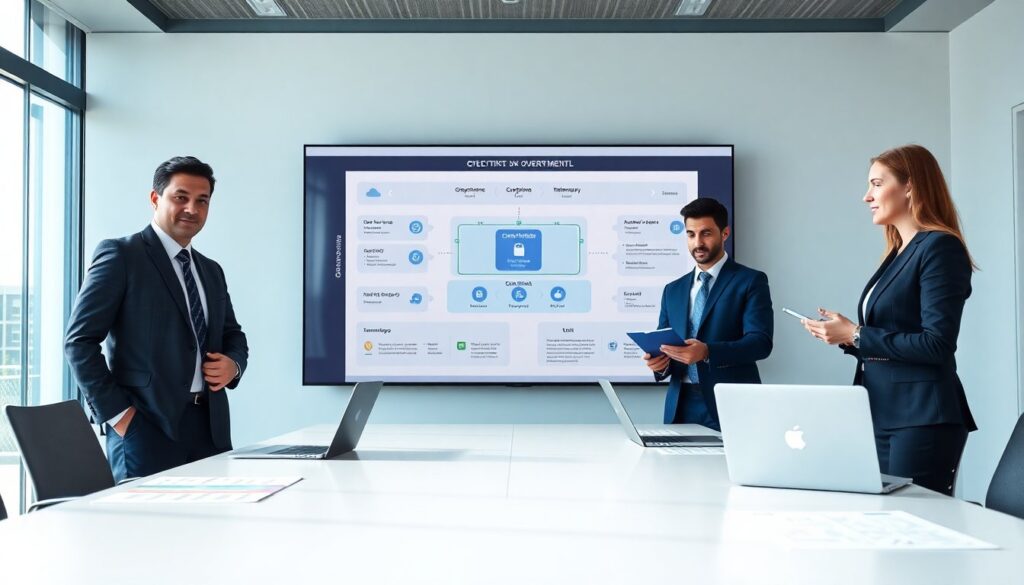
cybersecurity oneframework offers a single way to manage risk across systems. It brings policy, telemetry, and controls under one plan. The guide shows who should use the approach and how to map it to current tools. It sets a clear path from quick wins to full adoption. The reader will get practical steps that reduce risk and cut overlap in security work.
Key Takeaways
- Cybersecurity OneFramework provides a unified risk management approach that consolidates policy, controls, and telemetry to reduce risk and eliminate overlapping security efforts.
- The framework emphasizes a risk-first design by prioritizing critical assets and threat modeling to align security controls with business impact.
- OneFramework integrates controls, telemetry, and policy into a single automated flow, speeding up incident response and simplifying compliance reporting.
- Mapping OneFramework to existing security tools and standards like NIST and ISO helps streamline audits and ensures consistent evidence for compliance.
- Implementation begins with quick wins such as centralized logging and MFA enforcement, progressing to full adoption through automation and embedding policies into development pipelines.
- OneFramework suits organizations of all sizes and environments, including cloud, on-premises, and hybrid, improving clarity for small teams and reducing tool sprawl for large operations.
What OneFramework Is And Who Should Use It
OneFramework for cybersecurity is a unified risk management approach. It combines risk assessment, controls, logging, and policy into a single program. The framework lets teams reduce duplicated effort and speed up decisions. Security leaders, cloud architects, compliance officers, and dev teams should consider the framework. Small security teams gain clarity from OneFramework. Large security operations reduce tool sprawl with OneFramework. Third parties and auditors find consistent evidence when teams use OneFramework. The approach fits environments that use cloud, on-prem, or hybrid stacks. It also fits those who need faster incident response and clearer compliance mapping.
Core Principles And Architecture Of OneFramework
OneFramework uses a small set of clear principles. Each principle drives architecture decisions and daily work. The principles include risk-first decision making, single policy layer, shared telemetry, and control reuse. The architecture splits into three parts: policy and governance, control plane, and telemetry plane. Teams write policy once and apply it across cloud and on-prem. Controls run where they sit best and report into the telemetry plane. The telemetry plane collects logs, alerts, and metrics and feeds policy and response systems. The design reduces blind spots and speeds up remediation.
— Risk-First Design And Threat Modeling
Risk-first design puts assets and impact before tools. Teams identify critical assets and assign impact values. They model threats against those assets and prioritize controls by impact reduction. Threat modeling uses simple templates and regular reviews. Teams run tabletop exercises to validate models and adjust priorities. The process keeps the team focused on what matters and trims low-value work. Risk-first design lets teams adapt controls as threats change and keeps budgets aligned with business risk. The approach also makes decisions easier during incidents.
— Integrated Controls, Telemetry, And Policy Layer
OneFramework puts controls, telemetry, and policy in one flow. The policy layer defines allowed behavior and response actions. Controls enforce policy at endpoints, network, and cloud services. Telemetry feeds the policy layer and alerting systems with real-time data. Teams use common identifiers so alerts link to assets and owners. The flow lets automated responses run for low-risk incidents and routes high-risk incidents to analysts. The integration reduces manual triage and speeds up containment. It also creates a single source of truth for audits and reporting.
How To Map OneFramework To Your Existing Security Stack
Mapping OneFramework starts with an inventory. Teams list assets, tools, and data flows. They map each tool to a role: policy authoring, enforcement, telemetry collection, or response. Teams identify overlaps and gaps. They assign each control to a single owner and a single purpose. Next, teams define common formats for telemetry and set a central store for logs and metrics. Teams test the policy layer by applying rules to a small set of assets. They then expand rules in stages and measure the impact.
— Aligning OneFramework With NIST, ISO, And Cloud Controls
Teams map OneFramework controls to NIST and ISO control families. They document which OneFramework policy or control satisfies each standard item. For cloud environments, teams map OneFramework to the provider’s native controls and to CIS benchmarks. They use this mapping to generate compliance reports automatically. The mapping reduces audit time and shows auditors a clear path from policy to evidence. Teams keep the mapping in version control and review it after major changes.
Implementation Roadmap: Quick Wins To Full Adoption
Start with quick wins that prove value. Teams enable centralized logging for critical assets first. They apply a small set of high-value policies, like MFA enforcement and privileged access limits. Teams automate alerting for those policies and measure mean time to detect. Next, teams integrate enforcement controls and link telemetry to incident playbooks. They expand policy coverage in sprints and add automation for common responses. Teams run regular reviews to remove stale rules. For full adoption, they embed OneFramework in change control and in developer pipelines. Leadership tracks a small set of metrics and funds continuous improvement.