
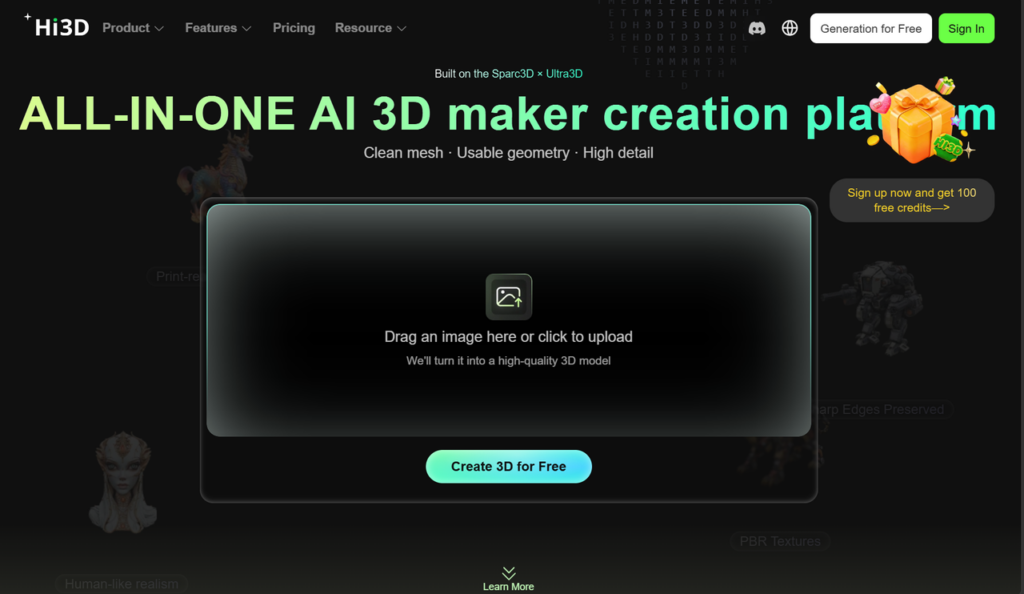
3D printing is gradually becoming part of everyday creativity. From customized figures and personalized gifts to product prototypes and educational projects, more people are using 3D printing to turn digital concepts into physical objects. However, creating a high-quality 3D model before printing remains one of the biggest challenges. Many users have creative ideas but lack professional modeling skills or the time required to build detailed assets manually.
The rise of AI 3D technology is changing this situation. By combining artificial intelligence with 3D creation, users can now transform images, text descriptions, and creative concepts into three-dimensional models more efficiently. AI is not only improving the speed of creation but also lowering the technical barrier for people who want to explore 3D printing.
Hi3D is designed for this new era of AI-powered creation. By integrating AI 3D generation, intelligent texture creation, and practical printing preparation tools, Hi3D helps users move from the first idea to the final physical object. With the release of Hi3D V3.0, the platform further improves model accuracy, texture quality, and production usability, bringing AI-generated 3D content closer to real-world applications.
1. Why AI 3D Creation Is Changing the Future of Digital Manufacturing
The development of 3D printing has expanded the possibilities of personal creation. In the past, producing a customized object often required professional design teams and complex manufacturing processes. Today, individuals, small studios, and creators can produce unique models with desktop 3D printers.
However, the creative process still has a major obstacle: building the 3D model itself.
Traditional modeling requires knowledge of software, topology, geometry, and digital sculpting. For beginners, this learning curve can prevent them from turning ideas into reality. Even professional creators may spend significant time creating basic structures before focusing on more important creative details.
AI 3D tools provide a new approach by allowing users to begin creation with simpler inputs. A photo, illustration, or text description can become the starting point for a 3D model.
Hi3D focuses on improving this entire process. Instead of only generating digital models, it works as a complete 3D model maker AI solution that helps users create, enhance, and prepare 3D assets for different applications.
2. Turning Images and Concepts into 3D Models with Hi3D
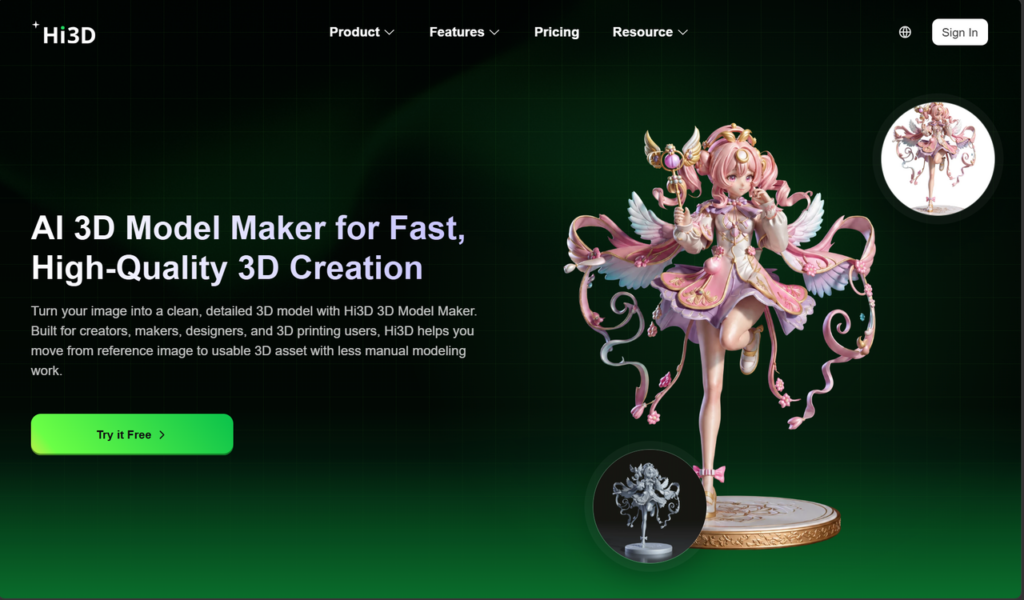
One of the biggest difficulties in 3D creation is transforming a visual idea into a three-dimensional structure. Many creators already have references, sketches, product concepts, or personal images, but converting these materials into printable models usually requires professional modeling experience.
Hi3D simplifies this process by using AI to understand visual information and generate corresponding 3D models, allowing more users to participate in 3D creation.
2.1 Creating 3D Models from Images Without Complex Modeling
The photo to 3D model feature allows users to transform two-dimensional images into 3D assets. Instead of manually creating shapes, adjusting surfaces, and building structures step by step, users can start with an image reference and let AI generate a three-dimensional interpretation.
This capability is useful for various creative scenarios.
For example, artists can transform their illustrations into physical figures. Designers can quickly create early product models from concept images. Individuals can also convert personal photos or creative pictures into customized 3D objects.
The advantage of image-based generation is that it connects existing visual creativity with 3D production. Users can focus on the idea itself instead of spending most of their time learning complex modeling techniques.
2.2 Expanding Creativity Through Text-Based 3D Generation
Images are not the only way to create with Hi3D. Text-based 3D generation provides another flexible approach for exploring ideas.
Users can describe a character, object, or design concept through natural language and use AI to generate a corresponding 3D model. This makes the early creative stage faster and more experimental.
For creators, this means more possibilities for testing different styles and concepts. For beginners, it provides an easier way to enter the world of 3D creation without requiring advanced technical knowledge.
3. AI Texture Generation Brings More Detail and Realism to 3D Models
A high-quality 3D model is not only about geometry. Surface details, colors, and materials strongly influence how a model looks and performs in practical scenarios.
Many AI-generated models can achieve impressive structures but still require additional work to improve their appearance. Manual texture creation can be time-consuming, especially for detailed characters, products, and creative assets.
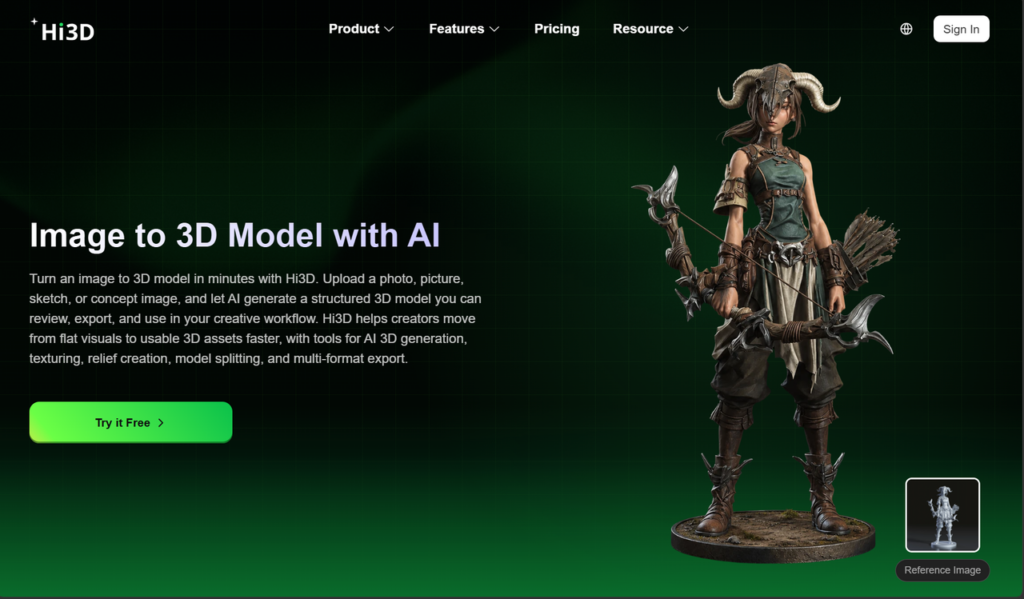
Hi3D improves this part of the workflow through AI texture generation, helping users create more complete and visually rich models.
3.1 Automatically Creating Detailed Model Surfaces
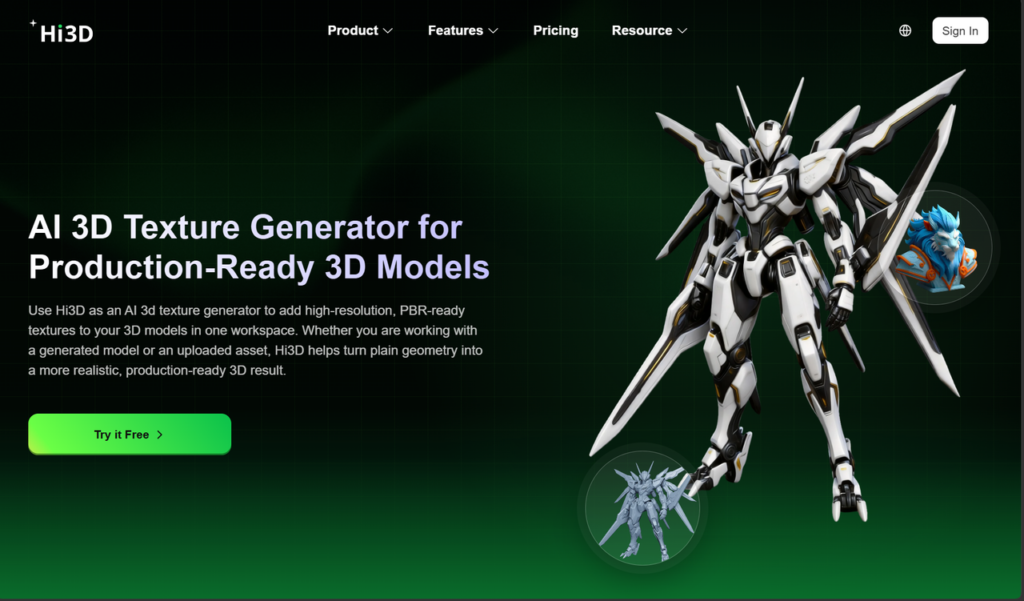
The AI 3D texture generator feature allows users to generate textures for 3D models more efficiently.
Instead of manually painting every surface detail, users can rely on AI to create visual information that improves the final appearance. This reduces repetitive editing work and allows creators to spend more time refining creative ideas.
For character creators, this can help add clothing patterns, colors, and surface details. For product designers, it can improve material presentation and visual prototypes. For digital artists, it provides a faster way to create detailed assets.
3.2 Hi3D V3.0 Improves Texture Quality for Better Applications
With Hi3D V3.0, texture generation receives further improvements. The official release states that V3.0 increases texture output capability up to 8K and upgrades the self-developed UV completion algorithm, improving pattern edge clarity, color transition consistency, and detailed texture recognition after enlargement.
This improvement allows AI-generated models to maintain richer visual information and provides stronger support for applications that require detailed surfaces.
For creators working on printable models, digital assets, or product visualization, higher-quality textures help make generated models closer to professional production standards.
4. Supporting the Full Journey from AI Model to Printed Object
Generating a model is an important step, but it is not the final stage of 3D creation. Before printing, users often need to solve additional problems, such as preparing colors, dividing large models, and optimizing printing arrangements.
Hi3D expands beyond AI generation by adding tools designed to support practical production workflows.
4.1 Multi-Color Printing for More Expressive Physical Models
Hi3D’s multi-color printing feature helps transform AI-generated textured models into printable multi-color objects.
The system focuses on improving color mapping between digital models and real filament materials. It can generate printable color regions, reduce unnecessary fragmented areas, and help users achieve more stable multi-color printing results.
For creators producing collectibles, character figures, and personalized products, this provides a smoother connection between digital design and physical output.
4.2 Split-for-Printing Helps Prepare Complex Models
Complex models often create difficulties during printing because they may exceed printer size limitations or require additional assembly preparation.
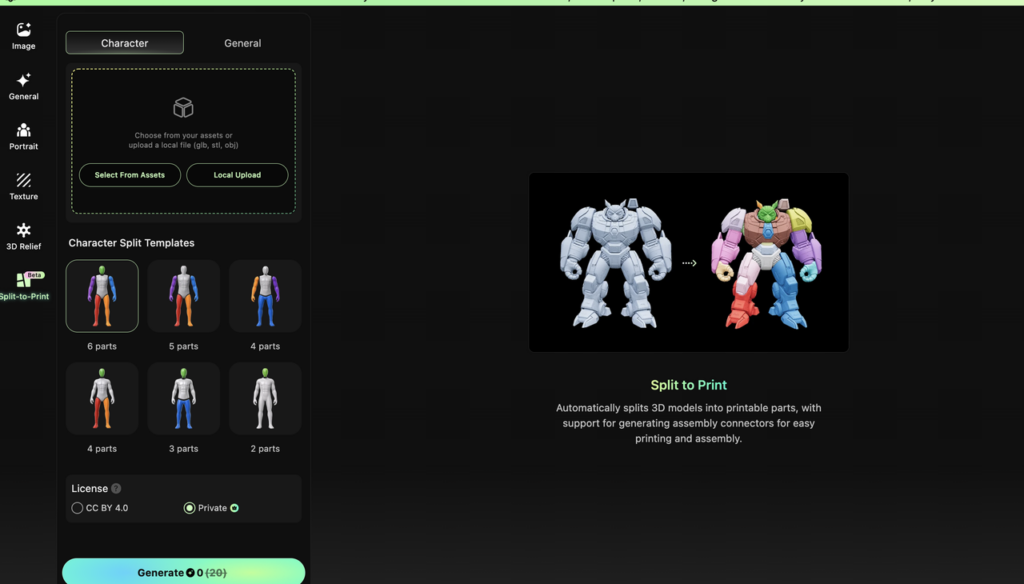
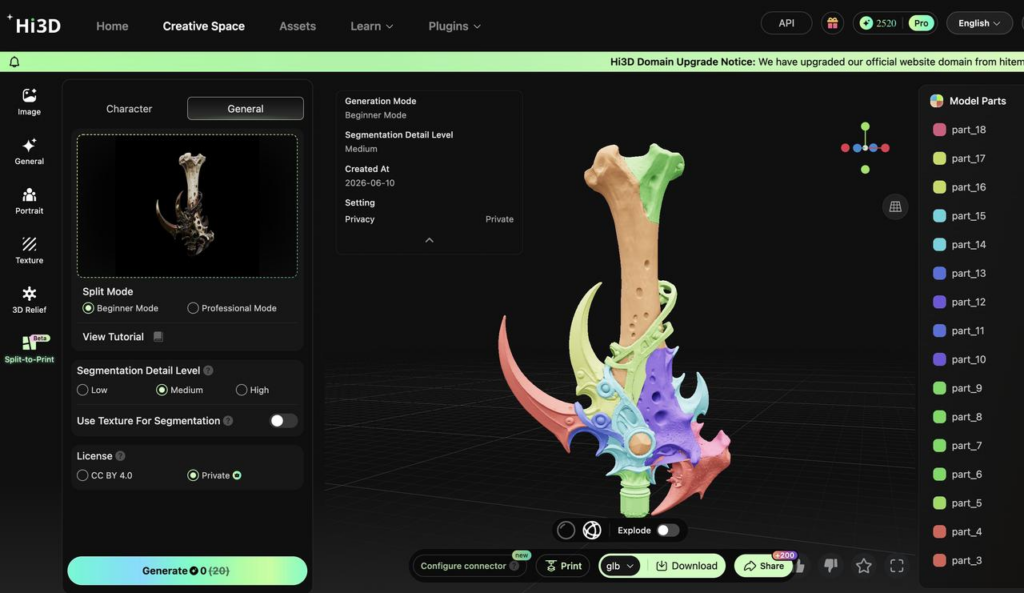
Hi3D’s split-for-printing function helps users separate models into printable parts and generate connectors when necessary. The system can divide character models into areas such as the head, torso, arms, legs, weapons, and base, while supporting different connector structures for assembly.
This makes it easier to produce larger models, collectible figures, and customized objects with desktop 3D printers.
|
|
|
5. Hi3D V3.0: A New Step Toward Production-Ready AI 3D Models
The launch of Hi3D V3.0 represents a major development in AI 3D creation. The goal of this upgrade is not only to improve generated visuals but also to make AI-created models more suitable for real production workflows.
According to the official announcement, Hi3D V3.0 is a new-generation general AI 3D model that improves geometric reconstruction resolution to 2048³ voxel-level, becoming the first commercially available AI 3D model with this level of precision. At the same time, it upgrades texture output to 8K and improves cross-view structure reasoning and self-developed UV completion technology.
5.1 Higher Precision for More Detailed Structures
One of the most important improvements in V3.0 is geometric accuracy.
The increase from 1536³ to 2048³ voxel-level reconstruction allows more small details to be preserved. Features such as feather layers, scales, text edges, mechanical structures, and subtle surface changes can be represented more clearly.
For creators, this means AI-generated models can better maintain important design information and become more suitable for detailed applications.
5.2 Stronger Structural Understanding Across Different Views
Another key improvement is better structural stability.
A single image only provides limited visible information, meaning AI needs to predict hidden areas and spatial relationships. Hi3D V3.0 improves multi-view understanding and reduces structural issues caused by complicated viewpoints, object interactions, and hidden sections.
This improvement helps create models that are more reliable for editing, displaying, and printing.
6. From Version Evolution to Real Industry Applications
The development of Hi3D shows a clear transition from AI model generation toward complete production support.
Hi3D V1.0 introduced commercial AI image-to-3D generation with 1536³ voxel resolution. V2.0 further integrated geometry and texture generation, improved hidden structure completion, and created a more complete workflow. V3.0 continues this progress by focusing on higher geometric precision, complex structure processing, improved textures, and production-oriented features.
These improvements are valuable across multiple industries.
In 3D printing, users need models that are accurate and printable. In gaming and digital art, creators need detailed assets with strong visual quality. In jewelry design, education, cultural projects, e-commerce content, and industrial design, professionals also require reliable 3D models that can continue into further applications.
Hi3D V3.0 aims to reduce the gap between AI-generated content and real production needs, allowing more industries and individual creators to access usable 3D assets.
7. Experience Hi3D V3.0 and Explore the Future of AI 3D Creation
The future of 3D creation is not only about generating models faster. A complete AI 3D workflow should help users move from ideas to models, from models to printing, and from digital concepts to physical results.
With image and text-based 3D generation, AI texture creation, multi-color printing, split-for-printing, and smart arrangement, Hi3D provides a more complete creative environment for users with different levels of experience.
The release of Hi3D V3.0 brings AI 3D creation to a new stage. Through 2048³ high-precision reconstruction, improved structure reasoning, enhanced texture quality, and production-focused features, Hi3D V3.0 helps transform creative ideas into more detailed, practical, and printable 3D assets.
To celebrate the official release, Hi3D is opening a 48-hour free experience for global users. From August 19, 2026, 00:00 to August 20, 2026, 24:00 (Beijing Time), users can experience Hi3D V3.0 through the official website with unlimited usage during the event period.
Whether you are a designer, maker, artist, educator, or simply someone interested in exploring 3D creativity, Hi3D V3.0 provides an opportunity to experience how AI can turn simple ideas into detailed three-dimensional creations.